Windenergie in Norwegen
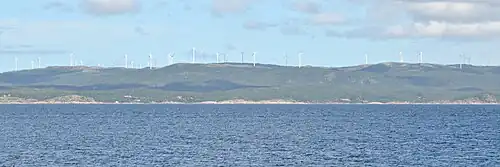
Die Windenergie in Norwegen hat eine zunehmende Bedeutung bei der Stromerzeugung des Landes: 2024 wurden etwa 11 % des Strombedarfs Norwegens mit Windkraftanlagen gedeckt.[1] Die Stromerzeugung in Norwegen erfolgte bisher vor allem mit Wasserkraft, vor allem enorm großen Speicherwasserkraftwerken, so dass auch ohne Windenergie ein sehr hohen Anteil an erneuerbaren Quellen bestand. Andererseits besteht Abhängigkeit von den jeweiligen Niederschlagsmengen, so dass in Dürreperioden Stromimporte nötig[2] werden.
Das in fünf Zonen aufgeteilte norwegische Stromnetz ist nicht nur terrestrisch mit den Nachbarländern Schweden, Finnland, Russland verbunden, sondern übers Meer auch mit Dänemark sowie über lange HGÜ-Leitungen in der Nordsee auch mit Deutschland (NordLink), Niederlande (NorNed), England (North Sea Link)[3].
Die meisten Windkraftanlagen Norwegens befinden sich an Land: von der im Jahr 2024 installierten Leistung von 5188 MW befanden sich 5087 MW an Land (98,1 %) und 101 MW waren offshore (1,9 %). Es bestehen zudem auch Stromleitungen im Meer um Erdgaspumpen zu versorgen.
Installierte Leistung und Jahreserzeugung
Die gesamte installierte Leistung der Windkraftanlagen (WKA) Norwegens stieg von 425 MW im Jahr 2010[4] auf 5188 MW Ende 2024[1], die Jahreserzeugung stieg von 2,12 TWh im Jahr 2016 auf 13,97 TWh im Jahr 2023[5].
| Jahr |
Inst. Leistung (MW)[4] |
Erzeugung (TWh)[6] |
|---|---|---|
| 2007 | 0,89 | |
| 2008 | 0,91 | |
| 2009 | 0,98 | |
| 2010 | 425 | 0,88 |
| 2011 | 512 | 1,28 |
| 2012 | 705 | 1,55 |
| 2013 | 818 | 1,88 |
| 2014 | 859 | 2,22 |
| 2015 | 867 | 2,51 |
| 2016 | 883 | 2,12 |
| 2017 | 1207 | 2,85 |
| Jahr |
Inst. Leistung (MW)[5][7] |
davon offshore (MW)[7] |
Erzeugung (TWh)[5][6] |
Anteil Wind |
|---|---|---|---|---|
| 2018 | 1710 | 2 | 3,88 | 2 %[8] |
| 2019 | 2914 | 2 | 5,52 | 4 %[9] |
| 2020 | 4030 | 2 | 9,91 | 7 %[10] |
| 2021 | 5049 | 6 | 11,77 | 8 %[11] |
| 2022 | 5062 | 66 | 14,82 | 11 %[12] |
| 2023 | 5064 | 101 | 13,97 | 10 %[13] |
| 2024 | 5188[1] | 101[1] | 11 %[1] | |
| 2025 |
Ausbaupläne
Norwegens Ministerpräsident Jonas Gahr Støre kündigte im Mai 2022 an, bis 2040 Offshore-Windenergieanlagen mit einer Gesamtleistung von 30 GW aufbauen zu wollen.[14] Dabei sollen zunächst schwimmende Windkraftanlagen mit einer Leistung von 1,5 GW in Betrieb genommen werden.[14] Es könnten in der norwegischen Industrie über 50000 Arbeitsplätze für schwimmende Offshore-Anlagen entstehen.[14] Die Ausschreibung für die ersten 1,5 GW Windkraft, die im nach der Insel Utsira benannten Gebiet Utsira Nord installiert werden sollen, wurde im März 2024 auf 2025 verschoben.[15]
Siehe auch
Weblinks

Einzelnachweise
- ↑ a b c d e Giuseppe Costanzo, Guy Brindley, Pierre Tardieu, Alexandre Frémaux, Francesco Meloni, Lizet Ramirez, Rory O’Sullivan: Wind energy in Europe: 2024 Statistics and the outlook for 2025-2030. In: WindEurope windeurope.org > WindEurope Intelligence Platform > Statistics. WindEurope, Brüssel, Februar 2025, abgerufen am 11. März 2025 (englisch).
- ↑ „During years of heavy precipitation, we may generate far more than what is consumed in Norway, while we may depend on imports from neighbouring countries during dry years.“ - https://www.statnett.no/en/for-stakeholders-in-the-power-industry/data-from-the-power-system/#the-power-situation
- ↑ https://www.statnett.no/en/for-stakeholders-in-the-power-industry/data-from-the-power-system/#import-and-export
- ↑ a b Renewable Capacity Statistics 2020. In: International Renewable Energy Agency www.irena.org. International Renewable Energy Agency IRENA, 31. März 2020, abgerufen am 16. März 2025 (englisch).
- ↑ a b c Electricity. In: Statistisk sentralbyrå / Statistics Norway www.ssb.no/en. Statistisk sentralbyrå, März 2025, abgerufen am 16. März 2025 (englisch).
- ↑ a b Norway Electricity. In: U.S. Energy Information Administration www.eia.gov > International. U.S. Energy Information Administration EIA, abgerufen am 17. März 2025 (englisch).
- ↑ a b IRENA – Renewable Capacity Statistics 2022. (PDF) In: International Renewable Energy Agency irena.org. International Renewable Energy Agency IRENA, April 2022, abgerufen am 11. Januar 2024.
- ↑ Ivan Komusanac, Guy Brindley, Daniel Fraile: Wind energy in Europe in 2018 - Trends and statistics. (pdf; 2,81 MB) In: windeurope.org. WindEurope, Brüssel, Februar 2019, abgerufen am 15. Januar 2021 (englisch).
- ↑ Ivan Komusanac, Guy Brindley, Daniel Fraile: Wind energy in Europe in 2019 – Trends and statistics. In: windeurope.org. WindEurope, Brüssel, Februar 2020, abgerufen am 15. Januar 2021 (englisch).
- ↑ Ivan Komusanac, Guy Brindley, Daniel Fraile, Lizet Ramirez, Rory O’Sullivan: Wind energy in Europe 2020 – Statistics and the outlook for 2021-2025. In: windeurope.org. WindEurope, Brüssel, Februar 2021, abgerufen am 4. April 2021 (englisch).
- ↑ Ivan Komusanac, Guy Brindley, Daniel Fraile, Lizet Ramirez und Rory O’Sullivan (Editor): Wind energy in Europe. 2021 Statistics and the outlook for 2022-2026. In: windeurope.org. WindEurope asbl/vzw, Brüssel, 24. Februar 2022, abgerufen am 22. März 2022 (englisch).
- ↑ Giuseppe Costanzo, Guy Brindley, Phil Cole; Editors: Rory O’Sullivan: Wind energy in Europe. 2022 Statistics and the outlook for 2023–2027 – Intelligence Platform – Reports. In: windeurope.org. WindEurope, Brüssel, Februar 2023, abgerufen am 4. März 2023 (englisch).
- ↑ Giuseppe Costanzo, Guy Brindley, Guy Willems, Lizet Ramirez, Phil Cole, Vasiliki Klonari; Editor: Rory O’Sullivan: Wind energy in Europe. 2023 Statistcs and the outlook for 2024–2030. In: WindEurope windeurope.org > Intelligence Platform > Reports. WindEurope, Brüssel, Februar 2024, abgerufen am 28. Februar 2024 (englisch).
- ↑ a b c Andreas Tang: Norway announces big new offshore wind targets. In: WindEurope windeurope.org. WindEurope, Brüssel, 2. Juni 2022, abgerufen am 17. März 2025 (englisch).
- ↑ Adrijana Buljan: Norway Postpones Floating Wind Tender to 2025 as Gov't Establishing 'Common State Aid Model'. In: Offshore Wind www.offshorewind.biz. 25. März 2024, abgerufen am 17. März 2025 (amerikanisches Englisch).