W Ursae Majoris
| Doppelstern W Ursae Majoris | |||||||||||||||
|---|---|---|---|---|---|---|---|---|---|---|---|---|---|---|---|
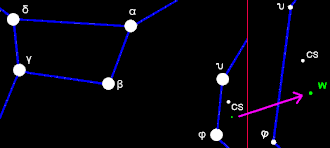
| |||||||||||||||
| Aufsuchkarte für W UMa | |||||||||||||||
| |||||||||||||||
| AladinLite | |||||||||||||||
| Beobachtungsdaten Äquinoktium: J2000.0, Epoche: J2000.0 | |||||||||||||||
| Sternbild | Großer Bär | ||||||||||||||
| Rektaszension | 09h 43m 45,470s [1] | ||||||||||||||
| Deklination | +55° 57′ 09,067″ [1] | ||||||||||||||
| Helligkeiten | |||||||||||||||
| Scheinbare Helligkeit | 7,75 (7,75 bis 8,48) mag[1][2] | ||||||||||||||
| Spektrum und Indices | |||||||||||||||
| Veränderlicher Sterntyp | EW/KW[2] | ||||||||||||||
| B−V-Farbindex | +0,79[1] | ||||||||||||||
| Spektralklasse | F8Vp + F8Vp[2] | ||||||||||||||
| Astrometrie | |||||||||||||||
| Radialgeschwindigkeit | (−29,6 ± 1,2) km/s[1] | ||||||||||||||
| Parallaxe | (19,28 ± 0,03) mas[1] | ||||||||||||||
| Entfernung | (169,09 ± 0,26) Lj (51,87 ± 0,09) pc | ||||||||||||||
| Eigenbewegung[1] | |||||||||||||||
| Rek.-Anteil: | (+17,15 ± 0,05) mas/a | ||||||||||||||
| Dekl.-Anteil: | (−29,23 ± 0,05) mas/a | ||||||||||||||
| Physikalische Eigenschaften | |||||||||||||||
| Masse | (1,19 / 0,57) M☉[3] | ||||||||||||||
| Radius | (1,08 / 0,78) R☉[4] | ||||||||||||||
| Andere Bezeichnungen und Katalogeinträge | |||||||||||||||
| |||||||||||||||


W Ursae Majoris (W UMa) ist ein bedeckungsveränderlicher Stern im Sternbild Ursa Major. Er ist der Prototyp der W-Ursae-Majoris-Sterne.
Sein Lichtwechsel wurde von den beiden Astronomen Müller und Kempf bei einer Zonenbeobachtung für die Potsdamer photometrische Durchmusterung im Jahre 1904 entdeckt.
W UMa ist ein Kontaktsystem, wobei beide Sterne eine gemeinsame Hülle besitzen und durch Gasströme Materie austauschen. Die Periode beträgt 0,33363749 Tage.
Weblinks
- BAV-Rundbrief 2/2008, H. Schmidt: W Ursae Maioris - Monographie eines Bedeckungsveränderlichen (PDF-Datei; 418 kB)
- https://www.aavso.org/vsots_wuma
Einzelnachweise
- ↑ a b c d e f W UMa. In: SIMBAD. Centre de Données astronomiques de Strasbourg, abgerufen am 2. November 2018.
- ↑ a b c W UMa. In: VSX. AAVSO, abgerufen am 2. November 2018.
- ↑ S. Bilir, Y. Karataş, O. Demircan, Eker, Z.: Kinematics of W Ursae Majoris type binaries and evidence of the two types of formation. In: Monthly Notices of the Royal Astronomical Society. 357. Jahrgang, Nr. 2, Februar 2005, S. 497–517, doi:10.1111/j.1365-2966.2005.08609.x, arxiv:astro-ph/0411291, bibcode:2005MNRAS.357..497B.
- ↑ K. Gazeas, K. Stȩpień: Angular momentum and mass evolution of contact binaries. In: Monthly Notices of the Royal Astronomical Society. 390. Jahrgang, Nr. 4, November 2008, S. 1577–1586, doi:10.1111/j.1365-2966.2008.13844.x, arxiv:0803.0212, bibcode:2008MNRAS.390.1577G.