Bridgewater Treatises
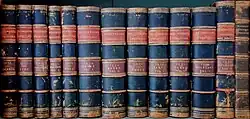
Die Bridgewater Treatises sind eine achtbändige, von 1833 bis 1836 erschienene, Reihe naturtheologischer Traktate, die von Francis Egerton, 8. Earl of Bridgewater, initiiert wurden.
Traktate
Originalausgaben
- The Bridgewater treatises on the power, wisdom and goodness of God, as manifested in the creation. 8 Bände, William Pickering, London 1833–1836:
- Band 1: Thomas Chalmers: On the power, wisdom, and goodness of God as manifested in the adaptation of external nature to the moral and intellectual constitution of man. 2 Bände, William Pickering, London 1833 (Band 1, Band 2).
- Band 2: John Kidd: On the adaptation of external nature to the physical condition of man: principally with reference to the supply of his wants and the exercise of his intellectual faculties. William Pickering, London 1833 (Digitalisat).
- Band 3: William Whewell: Astronomy and general physics considered with reference to natural theology. William Pickering, London 1833 (Digitalisat).
- Band 4: Charles Bell: The hand. Its mechanism and vital endowments as evincing design. William Pickering, London 1833 (Digitalisat).
- Band 5: Peter Mark Roget: Animal and vegetable physiology considered with reference to natural theology. 2 Bände, William Pickering, London 1834 (Band 1, Band 2).
- Band 6: William Buckland: Geology and mineralogy considered with reference to natural theology. 2 Bände, William Pickering, London 1836 (Band 1, Band 2).
- Band 7: William Kirby: On the power, wisdom and goodness of God as manifested in the creation of animals and in their history, habits and instincts. 2 Bände, William Pickering, London 1835 (Band 1, Band 2).
- Band 8: William Prout: Chemistry, meteorology and the function of digestion considered with reference to natural theology. William Pickering, London 1835 (Digitalisat).
Deutsche Übersetzungen
- Die Natur, ihre Wunder und Geheimnisse, oder die Bridgewater-Bücher. 9 Bände, Paul Neff, Stuttgart 1836–1838:
- Band 1: Charles Bell: Die menschliche Hand und ihre Eigenschaften. Paul Neff, Stuttgart 1836 (Digitalisat, Digitalisat) – übersetzt von Hermann Hauff.
- Band 2: William Prout: Chemie, Meteorologie und verwandte Gegenstände, als Zeugnisse für die Herrlichkeit des Schöpfers. Paul Neff, Stuttgart 1836 (Digitalisat) – übersetzt von Gustav Plieninger (1808–1886).
- Band 3: Peter Mark Roget: Die Erscheinungen und Gesetze des Lebens, oder populäre vergleichende Physiologie der Pflanzen- und Thierwelt. Band 1, Paul Neff, Stuttgart 1837 (Digitalisat) – Friedrich M. Duttenhofer.
- Band 4: Peter Mark Roget: Die Erscheinungen und Gesetze des Lebens, oder populäre vergleichende Physiologie der Pflanzen- und Thierwelt. Band 2, Paul Neff, Stuttgart 1837 (Digitalisat) – Friedrich M. Duttenhofer.
- Band 5: William Buckland: Die Urwelt und ihre Wunder. Paul Neff, Stuttgart 1837 (Digitalisat) – übersetzt von Friedrich Werner.
- Band 6: William Whewell: Die Sternenwelt, als Zeugniß für die Herrlichkeit des Schöpfers. Paul Neff, Stuttgart 1837 (Digitalisat) – übersetzt von Gustav Plieninger (1808–1886).
- Band 7: William Kirby: Die Thierwelt als Zeugnis für die Herrlichkeit des Schöpfers. Paul Neff, Stuttgart 1838 (Digitalisat) – übersetzt von Friedrich Oesterlen.
- Band 8: John Kidd: Der menschliche Körper und sein Verhältnis zur äußeren Natur. Paul Neff, Stuttgart 1838 (Digitalisat) – übersetzt von Gustav Plieninger (1808–1886).
- Band 9: Thomas Chalmers: Die innere Welt. Paul Neff, Stuttgart 1838 (Digitalisat) – übersetzt von Gustav Plieninger (1808–1886).
Rezeption
Einige Werke nahmen forthin einen hohen Stellenwert in der apologetischen Literatur ein. Eine erwähnenswerte Kritik stammt von Edgar Allan Poe.[1] Der Anatom Robert Knox verulkte die Reihe als Bilgewater Treatises (Bilgewasser-Traktat), was als Juxbegriff unter anderem in Briefen Charles Darwins vorzufinden ist. Als Trittbrettfahrer der Reihe veröffentlichte Charles Babbage einen von ihm als The ninth Bridgewater treatise bezeichneten Text.
Literatur
- John Robson: The Fiat and Finger of God: The Bridgewater Treatises. In: Bernard Lightmand, Frank Turner: Victorian Faith in Crisis: Essays on Continuity and Change in Nineteenth-Century Religious Belief. 1990, ISBN 0-333-49660-4.
- Jonathan R. Topham: Authors of the Bridgewater Treatises (act. c. 1833–1836). In: Henry Colin Gray Matthew, Brian Harrison (Hrsg.): Oxford Dictionary of National Biography, from the earliest times to the year 2000 (ODNB). Oxford University Press, Oxford 2004, ISBN 0-19-861411-X; doi:10.1093/ref:odnb/96360 (Lizenz erforderlich), Stand: 2004.
- Jonathan R. Topham: Reading the Book of Nature. How Eight Bestsellers Reconnected Christianity and the Sciences on the Eve of the Victorian Age. University of Chicago Press, Chicago / London 2022, ISBN 978-0-226-81576-3.