Tetrachloroaurate
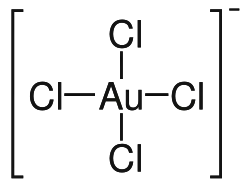
Tetrachloroaurate, nach IUPAC Tetrachloridoaurate, sind eine chemische Stoffgruppe. Es handelt sich um die Komplexsalze der Tetrachlorogoldsäure.
Vertreter
Tetrachloroaurate sind beispielsweise von Alkalimetallen bekannt (Lithiumtetrachloroaurat, Natriumtetrachloroaurat, Kaliumtetrachloroaurat, Rubidiumtetrachloroaurat und Caesiumtetrachloroaurat) sowie von organischen Kationen, beispielsweise Tetramethylammoniumtetrachloroaurat, Tetraethylammoniumtetrachloroaurat, Tetrabutylammoniumtetrachloroaurat und Tetraphenylarsoniumtetrachloroaurat.
Herstellung
Tetrachloroaurate können durch Reaktion von Tetrachlorogoldsäure oder Gold(III)-chlorid mit Chloriden gewonnen werden. So können beispielsweise Kaliumtetrachloroaurat, Natriumtetrachloroaurat und Ammoniumtetrachloroaurat hergestellt werden. Auch quartäre Ammoniumverbindungen können analog hergestellt werden.[1] Dazu gehört die Herstellung von Tetraethylammoniumtetrachloroaurat aus Tetraethylammoniumchlorid und von Tetrabutylammoniumtetrachloroaurat aus Tetrabutylammoniumchlorid.[2] Andererseits können durch Salzmetathese ausgehend von Natriumtetrachloroaurat oder Kaliumtetrachloroaurat auch andere Vertreter gewonnen werden, darunter ebenfalls die oben genannten quartären Ammoniumsalze sowie Caesiumtetrachloroaurat (mit Caesiumchlorid) und Tetraphenylarsoniumtetrachloroaurat (mit Tetraphenylarsoniumchlorid).[1]
Reaktionen und Verwendung
Durch Reaktion von Tetrachloroauraten mit elementarem Fluor bei 200 °C bis 300 °C oder mit Bromtrifluorid bei Raumtemperatur können Tetrafluoroaurate hergestellt werden.[1] Unter UV-Bestrahlung können Tetrachloroaurat-Ionen Chloroform zersetzen, wobei sie zu Dichloroaurat reduziert wird. In Gegenwart von Sauerstoff verläuft die Reaktion katalytisch, das heißt Tetrachloroaurat wird zurückgebildet.[3] Tetrachloroaurate wurden verschiedentlich zur Herstellung von Gold-Komplexen[4][5][6][7][8] und Nanopartikeln[9] verwendet.
Einzelnachweise
- ↑ a b c A. P. Hagen: Inorganic Reactions and Methods, The Formation of Bonds to Halogens (Part 2). John Wiley & Sons, 2009, ISBN 978-0-470-14539-5.
- ↑ Pierre Braunstein, Robin J. H. Clark: The preparation, properties, and vibrational spectra of complexes containing the AuCl 2 – , AuBr 2 – , and AuI 2 – ions. In: J. Chem. Soc., Dalton Trans. Nr. 17, 1973, S. 1845–1848, doi:10.1039/DT9730001845.
- ↑ Larissa R. Cohen, Laura A. Peña, Anton J. Seidl, Janet M. Olsen, Jennifer Wekselbaum, Patrick E. Hoggard: The photocatalytic decomposition of chloroform by tetrachloroaurate(III). In: Monatshefte für Chemie - Chemical Monthly. Band 140, Nr. 10, Oktober 2009, S. 1159–1165, doi:10.1007/s00706-009-0175-x.
- ↑ Kelly J. Kilpin, Rachael A. Linklater, William Henderson, Brian K. Nicholson: Synthesis and characterisation of isomeric cycloaurated complexes derived from the iminophosphorane Ph3PNC(O)Ph. In: Inorganica Chimica Acta. Band 363, Nr. 5, März 2010, S. 1021–1030, doi:10.1016/j.ica.2009.12.019.
- ↑ Samuel D.J. Brown, William Henderson, Kelly J. Kilpin, Brian K. Nicholson: Orthomercurated and cycloaurated derivatives of the iminophosphorane Ph3PNPh. In: Inorganica Chimica Acta. Band 360, Nr. 4, März 2007, S. 1310–1315, doi:10.1016/j.ica.2006.02.009.
- ↑ J. Vicente, M.T. Chicote, A. Arcas, M. Artigao, R. Jimenez: A new way of synthesising diarylgold(III) complexes using organomercury compounds. In: Journal of Organometallic Chemistry. Band 247, Nr. 1, Mai 1983, S. 123–129, doi:10.1016/S0022-328X(00)98837-5.
- ↑ Biao Zhou, Hiroyuki Yajima, Yuki Idobata, Akiko Kobayashi, Tetsuya Kobayashi, Eiji Nishibori, Hiroshi Sawa, Hayao Kobayashi: Single-component Layered Molecular Conductor, [Au(ptdt)2]. In: Chemistry Letters. Band 41, Nr. 2, 5. Februar 2012, S. 154–156, doi:10.1246/cl.2012.154.
- ↑ Steven L. Barnholtz, John D. Lydon, Gloria Huang, Meera Venkatesh, Charles L. Barnes, Alan R. Ketring, Silvia S. Jurisson: Syntheses and Characterization of Gold(III) Tetradentate Schiff Base Complexes. X-ray Crystal Structures of [Au(sal 2 pn)]Cl·2.5H 2 O and [Au(sal 2 en)]PF 6. In: Inorganic Chemistry. Band 40, Nr. 5, 1. Februar 2001, S. 972–976, doi:10.1021/ic001073m.
- ↑ Cristina Femoni, Maria Carmela Iapalucci, Giuliano Longoni, Cristina Tiozzo, Stefano Zacchini: An Organometallic Approach to Gold Nanoparticles: Synthesis and X‐Ray Structure of CO‐Protected Au 21 Fe 10 , Au 22 Fe 12 , Au 28 Fe 14 , and Au 34 Fe 14 Clusters. In: Angewandte Chemie International Edition. Band 47, Nr. 35, 18. August 2008, S. 6666–6669, doi:10.1002/anie.200802267.