Sulfolobus
| Sulfolobus | ||||||||||||
|---|---|---|---|---|---|---|---|---|---|---|---|---|
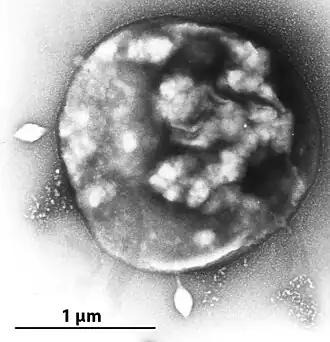
Eine Sulfolobus-Zelle, mit zwei | ||||||||||||
| Systematik | ||||||||||||
| ||||||||||||
| Wissenschaftlicher Name | ||||||||||||
| Sulfolobus | ||||||||||||
| Brock (1972) |
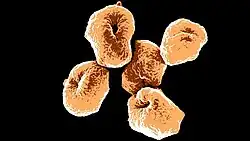
Sulfolobus ist eine Gattung von hyperthermophilen Archaea aus der Familie Sulfolobaceae im Reich Thermoproteati.[1][2][A. 1] Einige Vertreter sind darüber hinaus acidophil. Die Gattung wurde 1972 von Thomas D. Brock, einem US-amerikanischen Mikrobiologen, in der Zeitschrift Archiv für Mikrobiologie erstbeschrieben.[3] Sulfolobus-Arten wachsen in vulkanischen Quellen, wobei das optimale Wachstum bei einem pH-Wert von 2 bis 3 und Temperaturen von 75 bis 80 °C stattfindet, weshalb sie als acidophil bzw. thermophil gelten. Sulfolobus-Zellen sind unregelmäßig geformt und begeißelt. Vo der Gattung Sulfolobus wurde 2018 von Sakai & Kurosawa die neue Gattung Saccharolobus abgespalten;[4] und die Spezies Sulfolobus tokodaii wurde in diesem Jahr von Tsuboi et al. in die bereits bestehende Gattung Sulfurisphaera verschoben. Alle drei Gattungen, Sulfolobus, Saccharolobus und Sulfurisphaera gehören zur selben Familie Sulfolobaceae.[1][5][6]
Merkmale
Die Gattung Sulfolobus zeichnet sich durch die folgenden prägnanten Merkmale aus:
- kugelförmige Zellen, die häufig Lappen bilden
- fakultativ autotroph auf Schwefel oder einfachen organischen Verbindungen
- Zellwand ohne Peptidoglycan
- säureliebend, mit einem optimalen pH-Wert von 2–3, verträgt aber einen Bereich von 0.9 bis 5.8
- wärmeliebend mit einem Optimum von 70 bis 75 °C (Bereich 55 bis 80 °C)
Mittels eines Cäsiumchlorid-Gradienten wurde der GC-Gehalt des Erbgutes mit 60–68 % bestimmt.
Systematik
Artenliste mit Auswahl an Stämmen (ggf. MAGs bzw. 16S rRNA-Zugriffsnummern), Stand 14. Juli 2025:
Gattung Sulfolobus Brock et al. 1972(L,N,G)[3]
- Spezies Sulfolobus acidocaldarius Brock et al. 1972(L,N,G)[3]
- Stamm DSM 639(L,N,G) alias ATCC 33909, IFO 15157, JCM 8929, NBRC 15157 oder D14876(L,N)
- Stamm N8(N,G)
- Stamme Ron12/I(N) alias Ron12;I(G)
- Stämme GG12-C01-05; GG12-C01-05; NG05B_C06_13; …(G)
- Spezies Sulfolobus acidocaldarius_A(G)[A. 2]
- Stamm SUSAZ(N,G)
- Spezies „Sulfolobus ambivalens“ Zillig et al. 1985(L)[7]
- Spezies „Sulfolobus beitou“ – unveröffentlicht (Hung 2007 & Feng 2022)(N)
- Stämme 4-HJ; DBS(N)
- Spezies „Sulfolobus islandicus“ Zillig et al. 1994(L,N)[8] [„Saccharolobus islandicus“ (Zillig et al. 1994) Counts et al. 2021(L,N)][A. 3]
- Stamm REY15A – Fundort: Thermalquelle Reykjanes-Halbinsel, Island(N)
- Stamm HVE10/4 – Fundort: Thermalquelle bei Hveragerði, Island(N)
- Stamm M.16.27 – Fundort: Thermalquelle auf Kamtschatka(N)
- Stämme HVE10/4; L.D.8.5; L.S.2.15; LAL14/1; U.3.28; Y.G.57.14; Y.N.15.51, …(N)
- Spezies „Sulfolobus mongibelli“ Sokolova et al. 2012(N)
- Stamm SYET(N)
- Spezies „Sulfolobus neozealandicus“ Arnold et al. 2000(L,N)[A. 4][9]
- Stämme 4/2; 23/4(N)
- Spezies „Sulfolobus tengchongensis“ Xiang et al. 2003(L,N)[10] [inkl. Sulfolobus sp. RT8-4(N)] – wird vom Sulfolobus-Virus STSV1 parasitiert
- Stamm CGMCC 1.3345 alias RT8-4 oder AY135637(L,N)
- Spezies „Sulfolobus thuringiensis“ Fuchs et al. 1996(N)
- Stamm Ron12/I alias X90485(N)
- Spezies „Sulfolobus vallisabyssus“ – unveröffentlicht (Hung 2007)(N)
- Stamm F alias EF660336(N)
- Spezies Sulfolobus yangmingensis Jan et al. 1999(L,N)[11]
- Stamm YM1 alias AB010957(L,N)[11]
- Spezies Sulfolobus sp. A20-N-F6 – unveröffentlicht (Yun et al. 2018)(N)
- Stamm A20-N-F6(N)
- Spezies Sulfolobus sp. A20-N-F8 – unveröffentlicht (Yun et al. 2018)(N)
- Stamm A20-N-F8(N)
- Spezies Sulfolobus sp. A20-N-G8 – unveröffentlicht (Yun et al. 2018)(N)
- Stamm A20-N-G8(N)
- …
- Stamm A20-N-G8(N)
- (G) – Genome Taxonomy Database(G)[12]
- (L) – List of Prokaryotic names with Standing in Nomenclature(L)[1]
- (N) – Taxonomie des National Center for Biotechnology Information(N)[13]
Anm.: Der erstgenannte „Stamm“ (bzw. DNA-Sequenz, MAG) ist die Referenz.
Viren
Arten der Gattung Sulfolobus werden von einer Reihe sehr vielgestaltiger Viren parasitiert. Neben dem „Sulfolobus-Virus STSV1“ (vorgeschlagen als Mitglied der spindelförmigen Bicaudaviridae) sind dies u. a. folgende (mit Stand 14. Juli 2025 noch nicht offiziell bestätigte und klassifizierte) Viren:
-
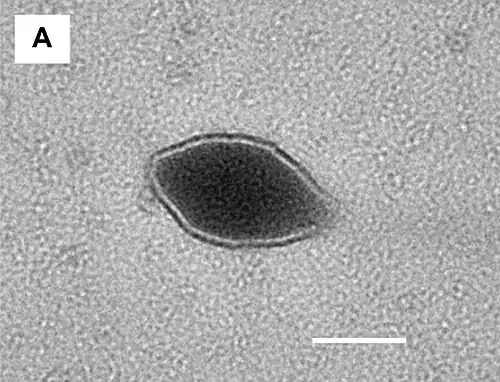 „Sulfolobus tailed spindle-shaped virus 3“ (STSV3), TEM-Aufnahme
 -
 Schemazeichnung
-
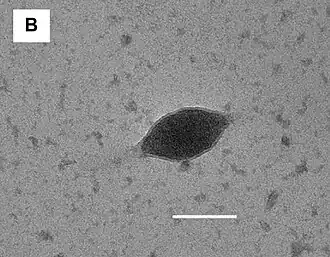 „Sulfolobus tailed spindle-shaped virus 4“ (STSV4), TEM-Aufnahme
 -
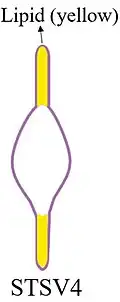 Schemazeichnung
-
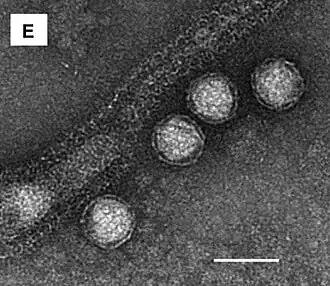 „Sulfolobus polyhedral virus 3“ (SPV3) alias „Sulfolobus turreted icosahedral virus 3“ (STIV3), TEM-Aufnahme
 -
 alias SPV3, Schamazeichnung
-
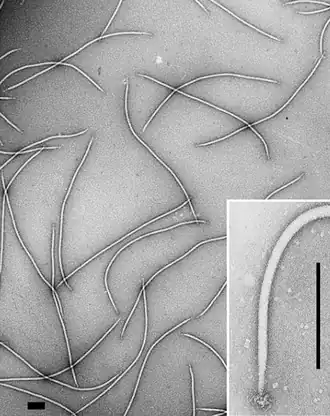 Sulfolobus islandicus filamentous virus (SIFV), Spezies Betalipothrixvirus hveragerdiense
Anmerkungen
- ↑ Die Genome Taxonomy Database (GTDB) verweist die Ordnung Sulfolobales in eine eigene Klasse Thermoprotei_A (manchmal auch als Sulfolobia bezeichnet).
- ↑ In der GTDB abgetrennt von Sulfolobus acidocaldarius; in der NCBI-Taxonomie nicht
- ↑ Die Spezies gilt in der NCBI-Taxonomie al nach Saccharolobus verschoben, nicht aber in der LPSN
- ↑ Von der Spezies sind bisher nur Plasmide sequenziert.(N)
Weblinks

- Thermophilic Archaea. National Park Service (NPS). Stand: 18. April 2025. Hitzeliebende Archaeen im Yellowstone-Nationalpark, insbesondere Sulfolobus im Congress Pool (Norris Geyser Basin) und Lemonade Creek. Memento im Webarchiv vom 6. April 2023.
- George Rice: Sulfolobus. Auf Microbial Life, Strengthening education through collaborative partnerships (SERC), carleton.edu, Stand 2009. Siehe insbes.: §Why Sulfolobus makes a good viral host for use in the lab. Aufnahme von Sulfolobus aus dem Yellowstone-Nationalpark mit Viren: Sulfolobus-spindle-shaped-Virus 1 (SSV-1), Spezies Alphafusellovirus beppuense (Fuselloviridae).
- Kinshuk Chandra Nayak: Comparative genome sequence analysis of Sulfolobus acidocaldarius and 9 other isolates of its genus for factors influencing codon and amino acid usage. In: Gene, band 513, Nr. 1, 15. Januar 2013, S. 163–173; doi:10.1016/j.gene.2012.10.024, PMID 23124074. Epub 30. Oktober 2012 (englisch).
Quellen
Benutzte Literatur
- Thomas D. Brock, Katherine M. Brock, Robert T. Belly, Richard L. Weiss: Sulfolobus: A new genus of sulfur-oxidizing bacteria living at low pH and high temperature. In: Archiv für Mikrobiologie. Band 84, März 1972, S. 54–68; doi:10.1007/BF00408082, PMID 4559703 (englisch).
Einzelnachweise
- ↑ a b c LPSN: Genus Sulfolobus Brock et al. 1972.
- ↑ Aidan C. Parte, Joaquim Sardà Carbasse, Jan P. Meier-Kolthoff, Lorenz C. Reimer, Markus Göker: List of Prokaryotic names with Standing in Nomenclature (LPSN) moves to the DSMZ. In: International Journal of Systematic and Evolutionary Microbiology. 70. Jahrgang, Nr. 11, 2020, ISSN 1466-5034, S. 5607–5612, doi:10.1099/ijsem.0.004332, PMID 32701423, PMC 7723251 (freier Volltext) – (englisch).
- ↑ a b c Thomas D. Brock, Katherine M. Brock, Robert T. Belly, Richard L. Weiss: Sulfolobus: A new genus of sulfur-oxidizing bacteria living at low pH and high temperature. In: Archiv für Mikrobiologie. Band 84, März 1972, S. 54–68; doi:10.1007/BF00408082, PMID 4559703 (englisch).
- ↑ Hiroyuki D. Sakai, Norio Kurosawa: Saccharolobus caldissimus gen. nov., sp. nov., a facultatively anaerobic iron-reducing hyperthermophilic archaeon isolated from an acidic terrestrial hot spring, and reclassification of Sulfolobus solfataricus as Saccharolobus solfataricus comb. nov. and Sulfolobus shibatae as Saccharolobus shibatae comb. nov. In: International Journal of Systematic and Evolutionary Microbiology. Band 68, Nr. 4, April 2018, S. 1271–1278; doi:10.1099/ijsem.0.002665, PMID 29485400, Epub 27. Februar 2018 (englisch).
- ↑ LPSN: Genus Saccharolobus Sakai and Kurosawa 2018.
- ↑ LPSN: Genus Sulfurisphaera Kurosawa et al. 1998.
- ↑ Wolfram Zillig, Siobhan Yeats, Ingelore Holz, August Böck, Felix Gropp, Michale Rettenberger, Scarlett Lutz: Plasmid-related anaerobic autotrophy of the novel archaebacterium Sulfolobus ambivalens. In: Nature, Band 313, 28. Februar 1985, S. 789–791; doi:10.1038/313789a0, PMID 2983223 (englisch).
- ↑ Wolfram Zillig, Arnulf Kletzin, Christa Schleper, Ingelore Holz, Davorin Janekovic, Johannes Hain, Martin Lanzendörfer, Jakob K. Kristjansson: Screening for Sulfolobales, their Plasmids and their Viruses in Icelandic Solfataras. In: Systematic and Applied Microbiology, Band 16, Nr. 4, Februar 1993, S. 609-628; doi:10.1016/s0723-2020(11)80333-4 (englisch).
- ↑ Hans Peter Arnold, Ulrike Ziese, Wolfram Zillig: SNDV, a Novel Virus of the Extremely Thermophilic and Acidophilic Archaeon Sulfolobus. In: Virology, Band 272, Nr. 2, 5. Juli 2000, S. 409-416; doi:10.1006/viro.2000.0375, PMID 10873785 (englisch).
- ↑ Xiaoyu Xiang, Xiuzhu Dong, Li Huang: Sulfolobus tengchongensis sp. nov., a novel thermoacidophilic archaeon isolated from a hot spring in Tengchong, China. In: Extremophiles, Band 7, 2. September 2003, S. 493–498; doi:10.1007/s00792-003-0355-2, PMID 12955604 (englisch).
- ↑ a b Ren-Long Jan, Jeffrey Wu, Shu-Miaw Chaw, Chien-Wei Tsai, Suh-Der Tsen: A novel species of thermoacidophilic archaeon, Sulfolobus yangmingensis sp. nov. In: Internationl Journnal of Systematic and Evolutonary Bacteriology. Band 49, Nr. 4, Oktober 1999, S. 1809-1816; doi:10.1099/00207713-49-4-1809, PMID 10555364 (englisch).
- ↑ GTDB: Sulfolobus.
- ↑ NCBI Taxonomy Browser: Sulfolobus, Details: Sulfolobus Brock et al. 1972. Rank: genus. Graphisch: Sulfolobus; auf: Lifemap.