Physalopterinae
| Physalopterinae | ||||||||||||
|---|---|---|---|---|---|---|---|---|---|---|---|---|
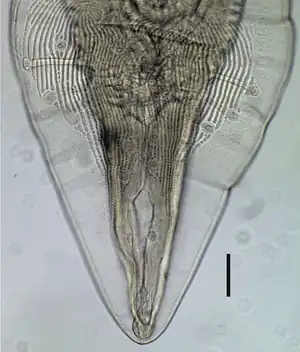
Vorderende von Physaloptera ngoci | ||||||||||||
| Systematik | ||||||||||||
| ||||||||||||
| Wissenschaftlicher Name | ||||||||||||
| Physalopterinae | ||||||||||||
| Railliet, 1893 |
Die Physalopterinae sind eine Unterfamilie der Rollschwänze mit 226 Arten.[1] Sie sind Parasiten aller Wirbeltierklassen außer den Fischen.[2]
Merkmale
Physalopterinae sind Camallanoidea, bei denen die Kaudalflügel der Männchen auf der Unterseite verbunden sind. Die Bursa copulatrix weist Ornamentierungen auf.[2]
Systematik
Hodda (2022) gliedert die Unterfamilie in die monotypische Tribus Physalopterini mit der Untertribus Physalopterinii, welche neun Gattungen enthält:[1]
- Abbreviata Travassos, 1920
- Didelphyoptera Schulz, 1927
- Didelphysoma Schulz, 1927
- Kreisiella Jones, 1985
- Mooleptus Ozdikmen, 2010
- Mirzaloptera Wason & Johnson, 1977
- Neoleptus Specian, Ubelaker & Dailey, 1975
- Ochetocephalus Linstow, 1907
- Paraphysaloptera Gupta & Jehan, 1971
- Pentadentoptera Schachnasarova, 1949
- Physaloptera Rudolphi, 1819
- Polydelphyoptera Schulz, 1927
- Pseudabbreviata Lichtenfels & Quigley, 1968
- Pseudophysaloptera Baylis, 1934
- Skrjabinoptera Schulz, 1927
- Turgida Schulz, 1927
Einzelnachweise
- ↑ a b Mike Hodda: Phylum Nematoda: a classification, catalogue and index of valid genera, with a census of valid species. In: Zootaxa. 2022, Band 5114, Nummer 1, S. 118, doi:10.11646/zootaxa.5114.1.1.
- ↑ a b Alain G. Chabaud: Keys to subclasses, orders and superfamilies. Nr. 1 von Roy C. Anderson, Alain G. Chabaud, Sheila Willmott (Hrsg.): CIH keys to the nematode parasites of vertebrates. CABI, 1974, S. 12.