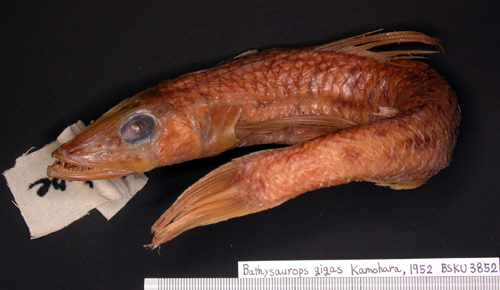
Bathysauroides gigas
| Bathysauroides gigas | ||||||||||||
|---|---|---|---|---|---|---|---|---|---|---|---|---|
| Systematik | ||||||||||||
| ||||||||||||
| Wissenschaftlicher Name der Familie | ||||||||||||
| Bathysauroididae | ||||||||||||
| Sato & Nakabo, 2002 | ||||||||||||
| Wissenschaftlicher Name der Gattung | ||||||||||||
| Bathysauroides | ||||||||||||
| Baldwin & Johnson, 1996 | ||||||||||||
| Wissenschaftlicher Name der Art | ||||||||||||
| Bathysauroides gigas | ||||||||||||
| (Kamohara, 1952) |
Bathysauroides gigas (Gr.: „bathys“ = tief; „saurodes“ = Eidechse) ist ein Tiefseefisch aus der Ordnung der Eidechsenfischverwandten (Aulopiformes). Die Art lebt im westlichen Pazifik auf dem Grund der Kontinentalhänge und wurde bisher bei Japan und Australien gefunden.
Merkmale
Bathysauroides gigas erreicht eine Maximallänge von 29 cm. Sein Körper ist schlank und annähernd zylindrisch, im Querschnitt fast rund und nur im hinteren Abschnitt wenig seitlich abgeflacht. Die Augen sind groß und sitzen dorsolateral. Die Pupillen sind elliptisch. Die einzige kurze Rückenflosse befindet sich in der vorderen Körperhälfte direkt über den Bauchflossen. Die Schwanzflosse ist gespalten.
Systematik
Bathysauroides gigas wurde 1952 durch den japanischen Ichthyologen Toshiji Kamohara als Bathysaurops gigas beschrieben und in die Familie der Netzaugenfische (Ipnopidae) gestellt. 1996 wurde für die Art die monotypische Gattung Bathysauroides aufgestellt und 2002 die Familie Bathysauroididae, die ebenfalls monotypisch ist.[1] Die Bathysauroididae sind die Schwestergruppe der Tiefsee-Eidechsenfische (Bathysauridae) und die von beiden gebildete Klade ist die Schwestergruppe der Teleskopfische (Giganturidae). Die drei Familien bilden zusammen mit den Bathysauropsidae und den Netzaugenfischen die Überfamilie Ipnopoidea in der Ordnung der Eidechsenfischartigen (Aulopiformes).[2][3]
Literatur
- Joseph S. Nelson, Terry C. Grande, Mark V. H. Wilson: Fishes of the World. Wiley, Hoboken, New Jersey, 2016, ISBN 978-1-118-34233-6. S. 271 u. 272.
- Paxton, J.R. & V.H. Niem, 1999. Ipnopidae: tripod fishes. Seite 1923–1924. In K.E. Carpenter & V.H. Niem (Hrsg.): FAO species identification guide for fishery purposes. The living marine resources of the Western Central Pacific. Band 3. Batoid fishes, chimaeras and bony fishes. Part 1 (Elopidae to Linophrynidae). FAO, Rome.
Einzelnachweise
- ↑ T. Sato & T. Nakabo (2002): Paraulopidae and Paraulopus, a new family and genus of aulopiform fishes with revised relationships within the order. Ichthyological Research, 49 (1), 25–46.
- ↑ Nelson (2016), Seite 270–272.
- ↑ Matthew P. Davis: Evolutionary relationships of the Aulopiformes (Euteleostei: Cyclosquamata): a molecular and total evidence approach. in J. S. Nelson, H.-P. Schultze & M. V. H. Wilson (Hrsg.): Origin and Phylogenetic Interrelationships of Teleosts. Verlag Dr. Friedrich Pfeil, München, Germany – ISBN 978-3-89937-107-9
Weblinks
- Family Bathysauroididae - Largescale deep-sea lizardfishes auf Fishbase.org (englisch)
- Bathysauroides gigas auf Fishbase.org (englisch)
- Foto auf einer Seite der Universität Kōchi.