Antarctophthirus
| Antarctophthirus | ||||||||||||
|---|---|---|---|---|---|---|---|---|---|---|---|---|
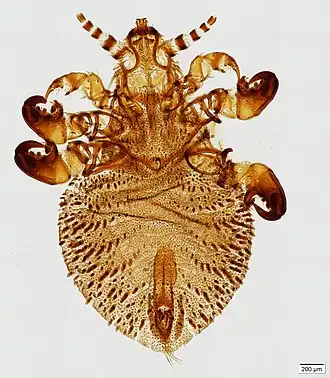
Antarctophthirus trichechi | ||||||||||||
| Systematik | ||||||||||||
| ||||||||||||
| Wissenschaftlicher Name | ||||||||||||
| Antarctophthirus | ||||||||||||
| Enderlein, 1906 |
Antarctophthirus ist eine Gattung der Tierläuse, deren Vertreter als Ektoparasiten Robben befallen. Gattungsspezifische Merkmale sind die fünfgliedrigen Antennen und die schuppenartigen Borsten (Setae).[1] Im Gegensatz dazu haben die ebenfalls beschuppten Lepidophthirus-Arten nur vier Antennensegmente.[2] Typspezies ist Antarctophthirus ogmirhini.[3]
Zur Gattung gehören folgende Arten:[3][4]
- Antarctophthirus callorhini, Wirt Nördlicher Seebär
- Antarctophthirus carlinii, Wirt Weddellrobbe
- Antarctophthirus lobodontis, Wirt Krabbenfresser
- Antarctophthirus mawsoni, Wirt Rossrobbe
- Antarctophthirus microchir, Wirte Australischer Seelöwe, Mähnenrobbe, Stellerscher Seelöwe
- Antarctophthirus ogmirhini, Wirte Seeleopard, Weddellrobbe
- Antarctophthirus trichechi, Wirt Walross
Einzelnachweise
- ↑ Chester J. Stojanovich: Key to Anoplura of North America. U.S. Department of Health, Education, and Welfare, Public Heath Service, Center for Disease Control, 1965, S. 2.
- ↑ Vernon Lyman Kellogg, Gordon Floyd Ferris: Anoplura and Mallophaga of North American Mammals. Stanford Univ. Pub., Univ. Ser. 1915, S. 7.
- ↑ a b Lance A. Durden & Guy G. Musser: The sucking lice (Insecta, Anoplura) of the world: a taxonomic checklist with records of mammalian hosts and geographical distributions. In: Bulletin of the American Museum of Natural History. Band 218, 1994, S. 7.
- ↑ Antarctophthirus. Abgerufen am 26. November 2024.