Alge des Jahres
Die Alge des Jahres wird seit 2007 von der Sektion Phykologie in der Deutschen Botanischen Gesellschaft ernannt[1]. Gekürt werden Arten beziehungsweise Gattungen, die in ihrer ökologischen Bedeutung oder ihrer Bedrohung hervorhebenswert sind.
Algen des Jahres
| Jahr | deutscher Name | wissenschaftlicher Name | Abbildung |
|---|---|---|---|
| 2007 | – | Laminaria | 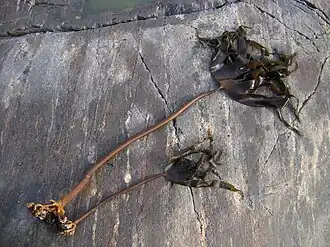
|
| 2008 | – | Micrasterias | 
|
| 2009 | – | Gephyrocapsa huxleyi [Emiliania huxleyi] |
.png)
|
| 2010 | Froschlaichalgen | Batrachospermum | 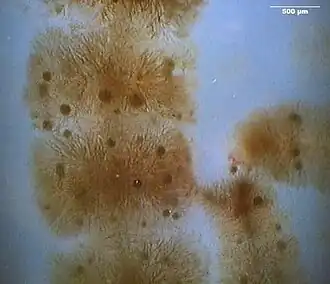
|
| 2011 | – | Fragilariopsis cylindrus | |
| 2012 | Armleuchteralgen | Chara | 
|
| 2013 | – | Lingulodinium polyedrum | 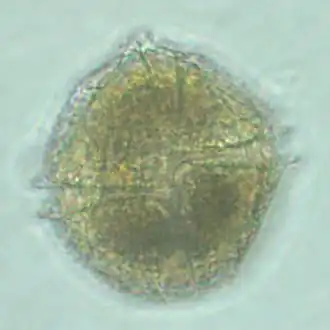
|
| 2014 | – | Chlamydomonas reinhardtii | 
|
| 2015 | Meersalat (Gattung) | Ulva | 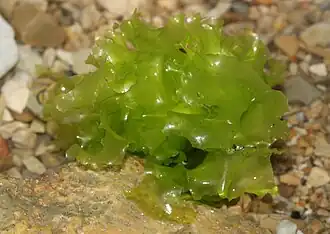
|
| 2016 | Melosira arctica | ||
| 2017 | Blaugrüne Felskugel | Chroococcidiopsis (Gattung) | 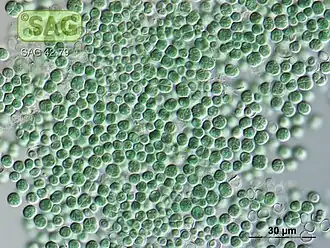
|
| 2018 | – | Klebsormidium (Gattung) | .jpg)
|
| 2019 | Blutschneealge | Chlamydomonas nivalis
(revidiert: Sanguina nivaloides)[2] |

|
| 2020 | – | Chromera velia | 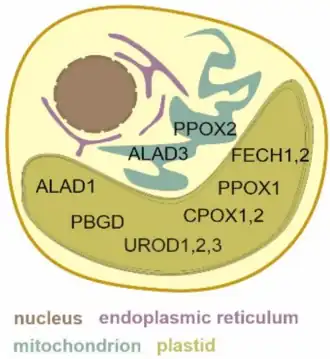
|
| 2021 | – | Vaucheria velutina | 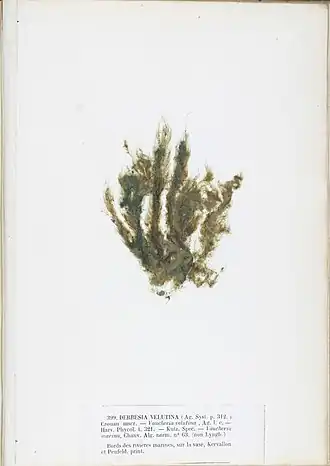
|
| 2022 | – | Stylodinium | 
|
| 2023 | – | Serritaenia | |
| 2024 | – | Sargassum | 
|
| 2025 | – | Draparnaldia erecta |
Weblinks
- Alge des Jahres, Sektion Phykologie der Deutschen Botanischen Gesellschaft (DBG).
Einzelnachweise
- ↑ https://www.dbg-phykologie.de/alge-des-jahres
- ↑ Lenka Procházková, Thomas Leya, Heda Křížková, Linda Nedbalová: Sanguina nivaloides and Sanguina aurantia gen. et spp. nov. (Chlorophyta): the taxonomy, phylogeny, biogeography and ecology of two newly recognised algae causing red and orange snow. In: FEMS Microbiology Ecology. Band 95, Nr. 6, 1. Juni 2019, ISSN 1574-6941, S. fiz064, doi:10.1093/femsec/fiz064, PMID 31074825, PMC 6545352 (freier Volltext).

| Allee | Arzneipflanze | Baum | Balkonpflanze | Biotop | Blume | Boden | Einzeller | Fisch | Flechte | Flusslandschaft | Fossil | Gartentier | Gemüse | Gestein | Giftpflanze | Heilpflanze | Heimlichtuer | Höhlentier | Insekt | Kaktus | Kartoffel | Landschaft (international) | Libelle | Mikrobe | Mineral | Moos | Naturparktier | Nutztierrasse | Orchidee | Pilz | Reptil/Lurch | Schmetterling | Seevogel | Speisepilz | Spinne | Staude | Streuobstsorte | (Wild-)Tier | Vogel | Versuchstier | Waldgebiet | Wasserpflanze | Weichtier | Wildbiene | Wirbelloses Tier | Zootier